Descending Eagle Design
A Craft Fair Designer’s Real-World Review
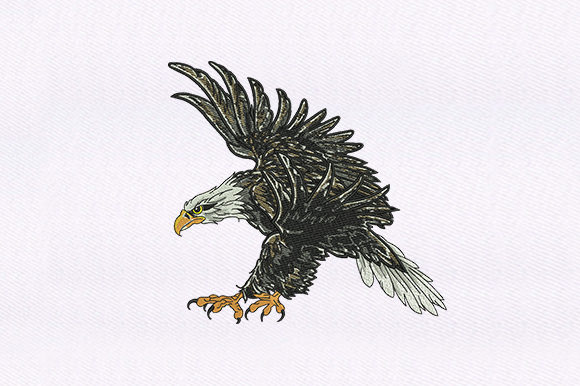
As an embroidery designer who’s prepped over 200 craft fair booths—and shipped thousands of handmade products—I opened Descending Eagle Design with one question: Will this stop someone mid-aisle? The answer? Yes—when placed right. This isn’t a cutesy robin or a whimsical chickadee. It’s a bold, downward-swooping eagle: strong, intentional, and instantly legible at 3–5 feet. It reads as modern rustic—not overly ornate, not cartoonish, not minimalist to the point of abstraction. Think farmhouse meets heritage workshop: grounded, confident, and quietly premium.
Where It Shines on Craft Fair Products
Tote bags are the first win. A medium-to-large (4.5"–6") Descending Eagle Design centered on a natural canvas tote reads clean and purposeful—no clutter, no apology. Customers associate that silhouette with quality craftsmanship, not mass production. Paired with earthy thread colors (charcoal gray, deep rust, forest green), it becomes a quiet signature piece.
Aprons follow closely—especially bib-style or cross-back designs. Positioned just above the waistband, the descending motion echoes the body’s natural line. It avoids looking “tacked on” and instead feels integrated, like part of the garment’s rhythm. Bonus: it photographs beautifully for Etsy listings and Instagram reels.
Tea towel embroidery works best when the design is scaled to 3.75"–4.25". Too large overwhelms the linen; too small loses impact. On textured, heavyweight cotton or Belgian linen, the eagle’s wing feathers hold up surprisingly well—if stitch density is balanced. Avoid ultra-dense fills in the tail or wingtips unless you’re using high-quality stabilizer and testing on scrap first.
Embroidered patches are where Descending Eagle Design earns repeat orders. Its clean outer edge and distinct negative space make it ideal for heat-seal or sew-on applications. At 2.5", it’s sharp on denim jackets, backpacks, or market bag straps—giving small shop products instant visual cohesion.
For caps, go no smaller than 3.25" width and use a low-profile hoop. The eagle’s downward angle actually helps here—it flows with the curve of the front panel better than horizontal motifs. Just avoid dark navy or black caps unless you confirm thread contrast in person; some file formats render fine feather details faintly on dense fabric.
Pillow covers and small fabric pouches benefit from its directional energy—placing the eagle so it “lands” toward the zipper or seam adds subtle narrative charm. And yes, it holds up beautifully in printable mockups. Its strong outline and moderate detail translate cleanly across digital assets used by Etsy sellers and boutique makers.
What Holds It Back (And How to Fix It)
This isn’t a “drop-in-and-stitch” design for beginners. Several practical notes:
- Dense stitch areas cluster near the eagle’s head and primary wing joint—test on your target fabric before batch production. On terry cloth towels or thick twill, those zones can pucker without proper cutaway stabilizer.
- Tiny details (like individual feather barbs) may blur below 3" wide. If you’re making embroidered keychains or mini pouches, simplify or omit those elements manually—or stick to 3.5"+ sizing.
- Curved surfaces (caps, curved market bags) demand careful hooping and possibly re-digitized underlay. Don’t assume the default file handles it.
- Dark fabric requires high-contrast thread—especially for the eagle’s eye and beak highlights. Always test thread colors against your base fabric, not your screen.
Selling & Production Reality Checks
At a craft fair, Descending Eagle Design stands out because it’s recognizable fast. No squinting. No reading a tiny title. Just shape, motion, and meaning. That speeds buyer engagement—critical when customers spend 8–12 seconds per booth item.
It also scales intelligently: same design, multiple roles. Use it large on a tote, medium on an apron, small on a patch—creating brand consistency without repetition fatigue. For small shop owners, that means fewer design assets to manage and more cohesive booth storytelling.
Photography is another strength. Its directional flow guides the eye naturally through product shots—ideal for scroll-stopping Etsy banners or Instagram carousels. Unlike floral or abstract motifs, it doesn’t compete with background textures or lighting flares.
Batch production? Very doable—if you verify hoop size compatibility across your machines first. With 17 embroidery file formats included (10O, ART, CND, DSB, DST, DSZ, EXP, HUS, JEF, PCS, PEC, PES, TAP, VIP, VP3, XXX), most commercial and home setups are covered. But don’t skip the test run: stitch one full design on scrap fabric *before* cutting your first tote panel.
Designer-to-Designer Must-Dos
Before selling any finished product featuring Descending Eagle Design, do these six things:
- Run a test stitch on your exact fabric + stabilizer combo—not just similar.
- Check thread contrast in natural light, not just under LED booth lighting.
- Review spacing between wingtip and edge on your target product (e.g., pillow seam or apron hem).
- Confirm hoop size requirements—some versions may need a 5x7" minimum; others fit 4x4".
- Inspect stitch density in high-detail zones. Adjust if needed for your fabric texture.
- Verify commercial licensing terms. As a machine embroidery design, its use in resale items depends on the license granted—not assumed.
Finally: make at least one real mockup. Not digital. Not pinned on foam board. A stitched, pressed, finished piece—held in hand, draped over a tote, tied on a market bag. That’s how you know whether Descending Eagle Design delivers on its promise: not just as a digital embroidery file, but as a craft fair product that sells, satisfies, and strengthens your handmade brand.